
Date: August 8, 2025 | Author: ABN News Bureau

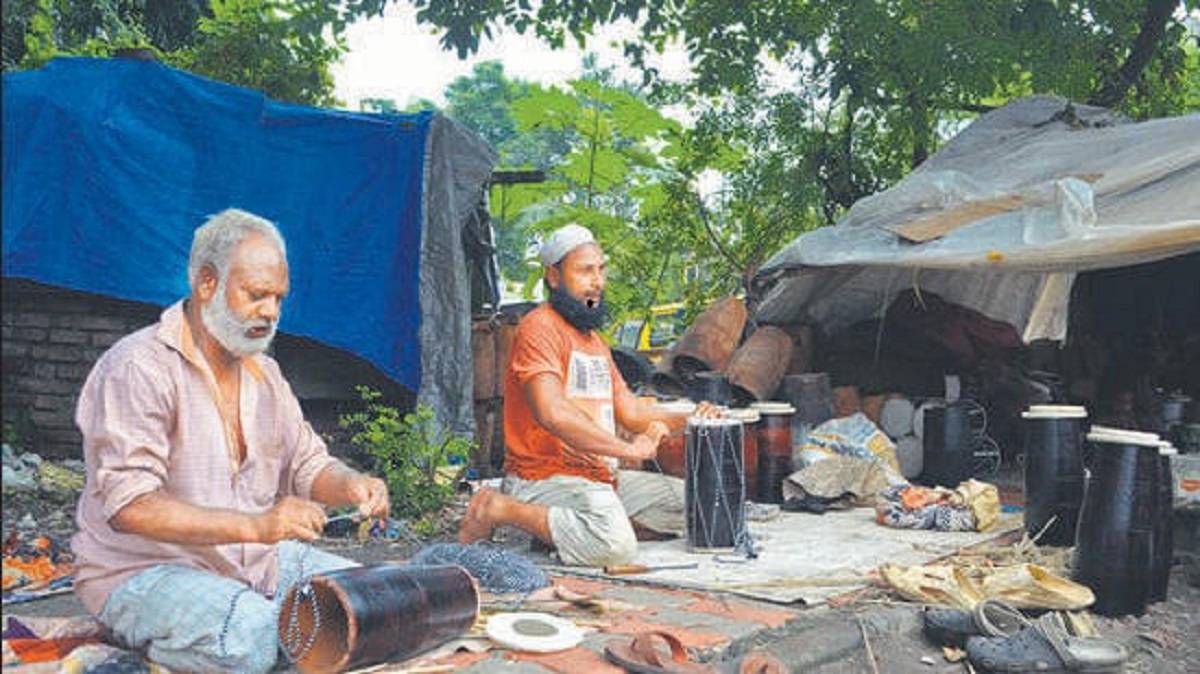
For over 70 years, around 90 families from the Shaikh community in Moradabad, Uttar Pradesh, have travelled to Kalyan, Maharashtra, just before the Ganapati festival. Their mission is clear — to make and sell hand-crafted dholkis, a percussion instrument that brings vibrant energy to the festivities.
From the arrival of the Ganesha idol to the aartis and the grand visarjan immersion, the beats of the dholki echo through the city. Their rhythm is not just music — it is tradition, identity, and a symbol of unity.
Generations of Tradition
These families, belonging to the Dholkiwali community, stay in Kalyan for about a month. In the narrow lanes of Bail Bazaar, the sound of hammers, ropes, and laughter blends with the smell of fresh leather and wood. Each dholki is crafted with precision, using materials brought from their home villages.
Mohammad Hasan, a 65-year-old artisan, has been visiting Kalyan since he was 15. “Our seven generations have never missed a single year,” he says. The wood and leather are prepared in Moradabad before their journey. Hasan adds, “Our dholkis can last five to six years if handled well. Now, when we cut wood, we also plant trees.”
Community Effort and Cultural Exchange
Dholki-making is a village-wide activity in Moradabad. Men, women, and children participate in preparing and selling the instruments. Many also perform at local events, adding live beats to aartis and processions.
Nijam Ali, 30, is continuing the tradition with pride. “We love this work. The sound, the tightness, the material — every detail matters. We prepare from August with the same excitement as the festival-goers here.”
Economic and Social Impact
In their first 15 days in Kalyan, each family makes about 150 dholkis. Prices range from ₹300 for small versions to ₹2,000 for larger ones. Most families earn around ₹15,000 during the season, a significant part of their annual income.
While some families face occasional discrimination, the inclusive spirit of the Ganapati festival remains strong. Khajana Shaikh, 45, notes, “The municipal staff and police know us well. Often, we are invited into temples and homes to play during aartis.”
Preserving Cultural Harmony
In an age where social connections are often digital, the Shaikh community’s presence keeps alive the cultural bond between Moradabad artisans and Maharashtra’s Ganapati celebrations. Every beat of their dholkis carries a message of unity, devotion, and joy.